Who does ChatGPT name for a Charlotte kitchen remodel?
One prompt, one engine, one clean session, logged verbatim on 25 August 2026. This is a single reading rather than a measurement, and it is published because it complicates the argument this practice usually makes.
On this page
What did ChatGPT actually say?
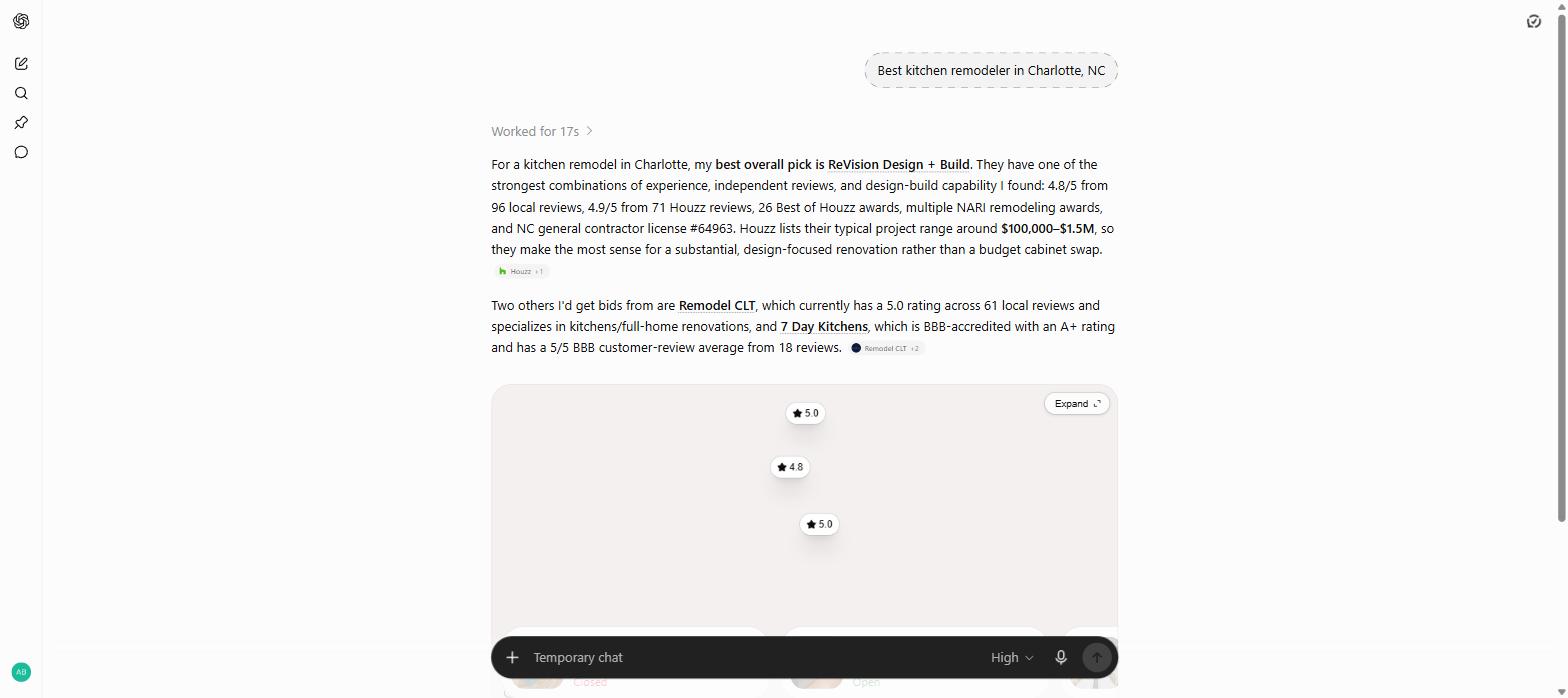
ChatGPT named three Charlotte firms and picked one outright. Asked “Best kitchen remodeler in Charlotte, NC” from a clean, signed-out temporary chat on 25 August 2026, it led with ReVision Design + Build as its best overall pick, then offered Remodel CLT and 7 Day Kitchens as the two other firms it would get bids from. No directory was recommended as the answer. Directories appeared instead as the sources underneath it, which turns out to be the more interesting part of the result.
Exhibit A · ChatGPT, temporary chat, 25 August 2026 · verbatim
Prompt: “Best kitchen remodeler in Charlotte, NC”
Answer: “For a kitchen remodel in Charlotte, my best overall pick is ReVision Design + Build. They have one of the strongest combinations of experience, independent reviews, and design-build capability I found: 4.8/5 from 96 local reviews, 4.9/5 from 71 Houzz reviews, 26 Best of Houzz awards, multiple NARI remodeling awards, and NC general contractor license #64963. Houzz lists their typical project range around $100,000–$1.5M, so they make the most sense for a substantial, design-focused renovation rather than a budget cabinet swap.
Two others I’d get bids from are Remodel CLT, which currently has a 5.0 rating across 61 local reviews and specializes in kitchens/full-home renovations, and 7 Day Kitchens, which is BBB-accredited with an A+ rating and has a 5/5 BBB customer-review average from 18 reviews.”
Why does this complicate the usual argument?
The standard pitch in this category, including the illustrative example on our own home page, is that AI engines answer local hire questions by pointing at Houzz, Angi, and Yelp instead of naming firms. That did not happen here. ChatGPT named three independent firms, ranked them, and gave a reason for each. Publishing a result that cuts against the pitch is the whole point of a field note: a measurement you only publish when it flatters you is marketing, not measurement.
The honest reading is that the directory-only answer is one possible outcome rather than the guaranteed one, and which outcome you get depends on the market, the phrasing, and the day. The 5W Public Relations study that most of this category quotes measured six categories that did not include remodeling, which is exactly why a remodeling-specific reading was worth taking.
Where did the evidence in that answer come from?
Almost none of it came from the firms’ own websites. Every specific ChatGPT used to justify its pick was a third-party record: Houzz review counts and Best of Houzz awards, a separate local review average, NARI awards, a North Carolina contractor license number, a Houzz-published project-range figure, and a Better Business Bureau accreditation with its review average. The cited sources shown under the answer were Houzz and the Better Business Bureau. The firms won the recommendation on corroboration they do not host and largely do not control.
| Signal ChatGPT cited | Where it lives | Controlled by the firm? |
|---|---|---|
| 4.8/5 from 96 local reviews; 4.9/5 from 71 Houzz reviews | Review platforms | No — earned |
| 26 Best of Houzz awards; multiple NARI awards | Houzz; trade association | No — earned |
| NC general contractor license #64963 | State licensing record | No — public record |
| Typical project range $100,000–$1.5M | Houzz profile | Partly — firm-supplied, platform-hosted |
| BBB accreditation, A+ rating, 5/5 from 18 reviews | Better Business Bureau | No — earned |
| Anything on the firms’ own websites | — | Not cited in this answer |
That is the practical lesson, and it is not the one a content agency would prefer. On this prompt, in this market, on this date, the recommendation was decided by review volume, awards, licensing records, and a directory profile — not by anybody’s homepage copy. It matches the third-party corroboration signal described in the seven-step method, which is the slowest and least glamorous of the seven, and it is a reason to be skeptical of anyone selling AI visibility as purely a website exercise.
What can and cannot be concluded from one run?
Very little can be concluded, and saying so is the point. This is one prompt, run once, on one engine, in one city, on one date, by a signed-out session that may not resemble yours. It is a reading, not a citation-share figure. A real measurement holds a set of roughly 25 prompts fixed, runs each three times, records the answer that repeats, and re-runs the identical set every cycle so that a change in the number means a change in the market rather than a change in the question.
- Not established: that Charlotte is representative, that these three firms hold the position on other phrasings, or that the same answer appears tomorrow.
- Not established: anything about the firms themselves. The ratings, awards, and license details above are ChatGPT’s claims, quoted verbatim and not independently verified here.
- Reasonably suggested: that in at least some remodeling markets, engines will name independent firms rather than defaulting to directories, and that the evidence they cite skews heavily toward third-party records.
- Worth running yourself: the same prompt for your city takes two minutes in a signed-out session and tells you more about your position than any vendor deck.
The ten-metro study this note is a fragment of is still in production. When it publishes it will carry the full prompt set, run counts, and every logged answer, and it will publish whatever it finds. The method is written down here so that it can be checked against the results when they arrive.
Questions about this reading
Is this a citation-share measurement?
No, and it should not be quoted as one. Citation share is the percentage of a fixed set of roughly 25 tracked prompts where an engine names a firm, with each prompt run three times and the repeating answer logged. This note is a single run of a single prompt. It is published as an exhibit of what a logged answer looks like and what an engine leaned on, not as a score for any firm or market.
Are the firms named here clients?
No. None of the three firms is a client of AI Visibility Partners, none was contacted, and none had any involvement in this note. They appear because an AI engine named them in response to a public prompt, and quoting that verbatim is the whole method. Every factual detail about them in the answer above is ChatGPT's statement rather than a claim made or verified here.
Why publish a result that undercuts your own pitch?
Because the alternative is publishing only the runs that help, which is the behavior this practice tells buyers to walk away from. The illustrative example on the home page shows an engine recommending three directories and naming no firm; that is a real pattern and it is labeled illustrative. This note shows the opposite outcome in a real market on a real date. Both are true, and a buyer deserves to see the second one before paying for the first.
Does this mean website work does not matter?
No, but it does mean website work is not sufficient on its own. On this prompt the engine cited review platforms, trade awards, a licensing record, and a directory profile, and did not cite any firm's own site. Content structure and schema are what make a page quotable once an engine reaches it; corroboration is what gets a firm into the candidate set in the first place. A vendor selling only the first half is selling half the job.
Where should you read next?
The method behind this note, and the two pages that explain what it is a fragment of.
Austin Brewer founded AI Visibility Partners in 2026, and also founded the interior design studio Astratto Design — a connection disclosed on who we work with because this practice sells to design firms. hello@aivispartners.com